
Founded in 1986, Liberty Counsel Action is a law and policy education, training and advocacy organization. From offices in Washington, DC and Orlando, Florida, LCA advances religious freedom, the sanctity of human life, the family, responsible government, national security, and support for Israel at the federal, state, and local levels. All contributions are made with the understanding that this ministry has complete discretion and control over use of donated funds. If the project described is fully funded, delayed or canceled, excess funds will be committed to the need most closely identified with the purpose for which the funds were originally given. Liberty Counsel Action is a 501(c)(4) tax-exempt nonprofit organization. Donations are not tax deductible. Privacy Policy.
Advancing Life and Liberty Through Action
While the official comment period has closed, the fight for embryonic life is ongoing — learn more at LCAction.org/ivf
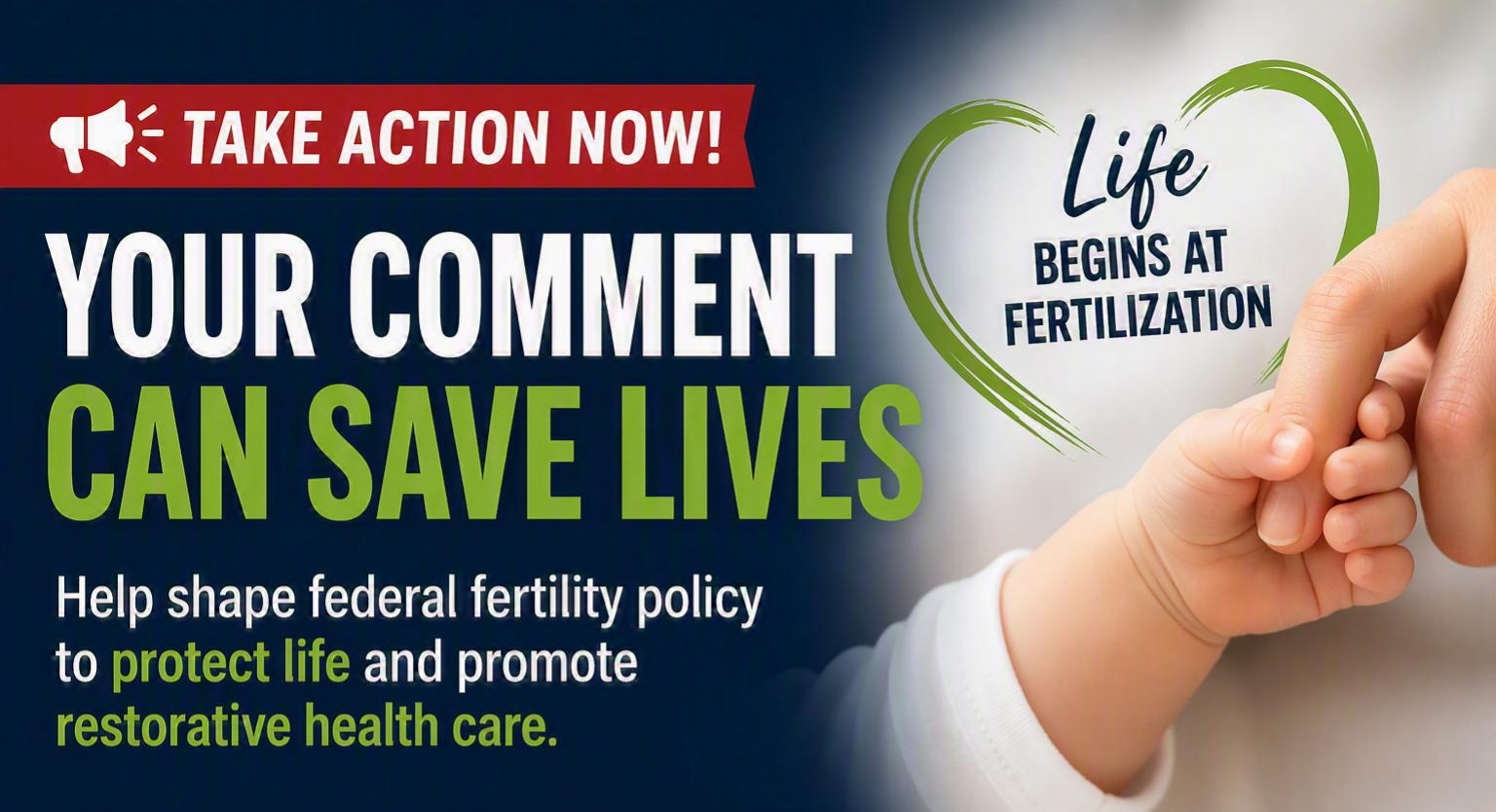
URGENT ACTION ALERT: Ask Government Officials to protect life and promote restorative health care.
Early in his second term President Trump declared, "our public policy must make it easier for loving and longing mothers and fathers to have children."
His administration is looking to do just that in a new way: Three federal departments have proposed rules that would make it easier for employers to offer insurance coverage for fertility-related care. The proposed rules are currently subject to a public comment period closing on Monday, July 13.
As proposed, it is entirely optional for employers, similar to how employers may opt to offer dental and vision plans. However, the rules would allow coverage for assisted reproductive technologies, including in vitro fertilization (IVF). Outside of stringent safeguards, this raises serious concerns, making public input vital. Indeed, this is an unprecedented opportunity to influence fertility-related policy at the federal level. Your comment can have a dramatic impact on the final rules by urging standards that protect life and promote responsible health care!
To be clear: Every child born through vitro fertilization (IVF) has incalculable worth and value, just as any child conceived and born naturally. Liberty Counsel Action celebrates these lives while also recognizing the sobering reality that standard fertility industry practice results in more failures than successful live-births. The emotional pain and financial struggles for the couples involved are impossible to overstate.
In addition, the fertility industry is often referred to as the “Wild Wild West” when it comes to regulatory requirements. There are very few protections in place, which has led to:
- The destruction or indefinite freezing of millions of tiny lives (embryos) annually.
- Massive breaches of medical and professional ethics, such as implanting another couple’s embryo and the promotion of eugenic practices. In one case, a mother was forced to give up the child she carried for 9 months—a child she believed to be her own and had determined to raise—to the biological parents, leaving her "emotionally and physically broken."
- Tragic surrogacy stories, including one in which a Tier-1 registered sex offender was able to gain custody of a child via surrogacy without so much as a background check.
- A woke definition of infertility that includes LGBTQ couples with no actual medical condition that may cause infertility (rather, someone may be considered "infertile" due to their lifestyle choices).
This comment period is an opportunity to tell the federal government that a life is a life regardless of developmental stage, and that infertility is a medical condition—not a lifestyle choice—best treated when patient health is addressed holistically through restorative care approaches.
As the rule itself is quite sparse, your input may make a big difference to the final version!
The comment period is only open until July 13. Join us in convincing the government to protect life and promote restorative fertility care by submitting a comment today!
- To read Liberty Counsel Action's comment, click here.
- To submit a pre-prepared comment, click here.
- To submit your own, unique comment utilizing our "Top 20 Reasons" to ensure life-affirming fertility practices, click here.
While any action will make an impact, comments reflecting unique perspectives are particularly powerful. As the federal government outlines, agencies “must respond to relevant and significant comments,” and “the perspective of individual persons” is especially valuable!
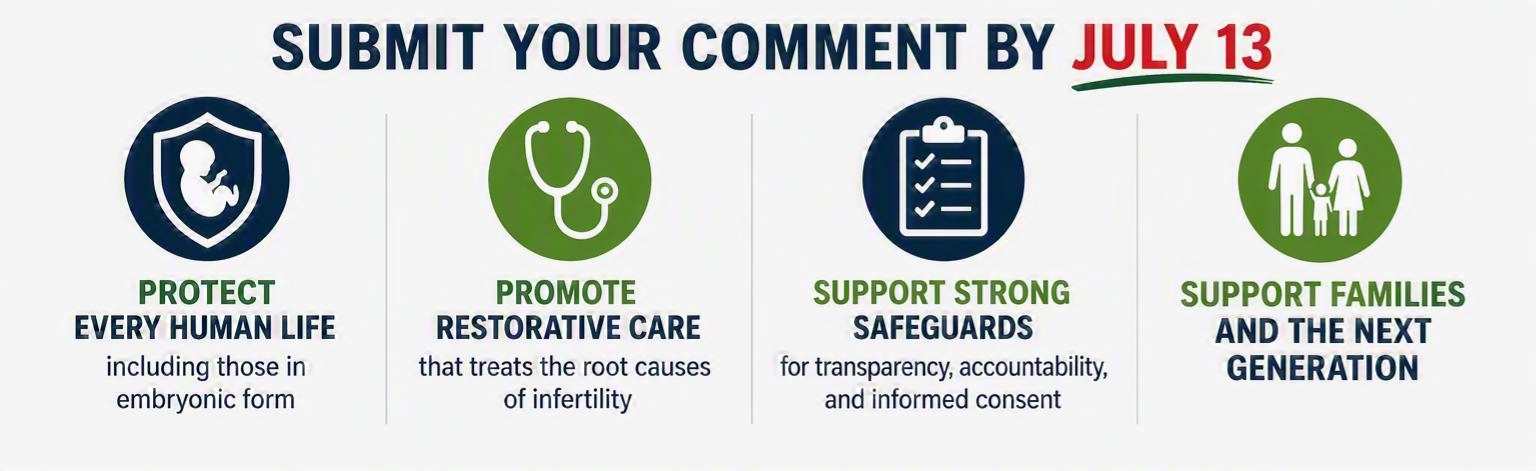
To submit the prepared comment below, follow these steps:
- Click the following link: https://www.regulations.gov/commenton/EBSA-2026-0232-0001
- Copy the comment below and paste it into the "Comment" section.
- Follow all the instructions on the page. Be sure to fill out each relevant field and the reCAPTCHA.
- Click submit.
Subject line (File code required): Re: file code 1210-AC40 - Protect life and promote restorative health care.
To the relevant officials at the Department of the Treasury, Department of Labor, and Department of Health and Human Services,
I support the administration’s efforts to help Americans build families and overcome infertility by establishing excepted fertility benefits. To that end, just as the recent Embryo Adoption Awareness and Services grant opportunity issued by the Office of Population Affairs (OPA) recognizes that embryos are "children who already exist and are in need of a family,” I urge the proposed rule be founded on the truth that life begins at fertilization, and to guarantee protections for those lives.
Additionally, any federal initiative that expands fertility benefits must be based on a medically oriented definition of infertility (excluding lifestyle choices) and focus first on diagnosing and treating the underlying causes of infertility, rather than promoting IVF. Specifically, coverage for infertility should be based on the following definition: Infertility is a clinical condition that presents with the symptom of inability to conceive or sustain a pregnancy that points to underlying male and/or female pathology.
Indeed, too often, women seeking answers to "unexplained infertility" are directed to IVF when a true diagnosis is available. IVF leads to higher risk pregnancies and usually results in more lives lost than gained, with far more embryos destroyed, discarded, frozen, or lost at various stages of pregnancy than carried to term. Furthermore, it frequently requires multiple rounds, often resulting in overall costs of $40-60,000.
In contrast, restorative care is often far less expensive, can improve overall health, increase the likelihood of natural conception, and reduce the risk of pregnancy complications, including miscarriage. Indeed, the recent MAHA Strategy and related HHS infertility initiatives, as well as the Title X grant opportunity announcement related to infertility, all recognize the importance of supporting restorative approaches, like Restorative Reproductive Medicine (RRM), which seeks to identify and treat underlying causes of infertility in both men and women. RRM has in fact been shown to achieve meaningful live-birth rates higher than that of a "single cycle of IVF with a single embryo transfer," and similar to IVF among couples who previously experienced failed IVF attempts. Taxpayers and patients deserve policies that prioritize effective, affordable, and preventative care before resorting to high-cost, invasive interventions.
To that end, I recommend the final rule explicitly allow coverage focused on restorative care options like RRM and NaProTechnology, among others, all of which fulfill the rule's stated intent that benefits be used for the "diagnosis, mitigation, or treatment of infertility or infertility-related reproductive health conditions."
The federal government should also recognize the need for stronger oversight of the fertility industry. Numerous highly publicized incidents have involved embryo mix-ups and mislabeled embryos, putting the wrong sperm with the wrong egg, storage failures that destroyed thousands of embryos, and other serious errors. Current practices also permit morally unconscionable outcomes, such as a Tier-1 registered sex offender obtaining custody of a child via surrogacy.
Given this reckless behavior, coverage under this benefit should exclude assisted reproductive technologies (ART) like IVF until and unless strong safeguards are implemented. As the administration has stated in their Embryo Adoption Awareness funding opportunity, children—including those in embryonic form—deserve to have their rights, best interests, and long-term well-being considered. Patients deserve transparency, accountability, and robust safety standards. Therefore, if IVF is allowed, the following safeguards should apply:
- It should be conditioned on receiving RRM.
- It should be subject to the following meaningful safeguards:
- Couples should be provided with comprehensive informed consent regarding risks and success rates, as well as information about less-invasive alternatives, and clinics eligible for reimbursement should be subject to comprehensive reporting and inspection requirements.
- Clinics eligible for reimbursement should be required to implant all embryos created.
- Clinics eligible for reimbursement should also be expressly prohibited from freezing or discarding embryos; practicing "selective reduction” (abortion) if more than one embryo is implanted; engaging in genetic testing and embryo selection based on certain traits, like sex, which is a form of modern-day eugenics; and participating in surrogacy or anonymous sperm donation, given the documented harm to children conceived through such arrangements.
- As it is typical with standard insurance policies to limit coverage to spouses, and because treating infertility should be centered on achieving natural biological outcomes, IVF coverage should be limited to heterosexual married couples.
Finally, I support the voluntary nature of the proposed rule, which is critical to maintain robust freedom of conscience protection for employers. Likewise, individuals with faith-based objections to IVF who desire to participate in plans providing both ART/IVF and RRM coverage should be able to do so without subsidizing IVF through their premiums.
In summary, expanding access to fertility care should mean expanding access to treatments that restore reproductive health—not increasing reliance on IVF. Federal fertility policy should both ensure robust protections for embryonic children and prioritize holistic health care resulting in healthier moms, dads, and babies.
Thank you for your consideration of these vital issues.
To submit a comment using our "Top 20 Reasons" to promote restorative care and ensure life-affirming fertility practices:
- Click the following link: https://www.regulations.gov/commenton/EBSA-2026-0232-0001
- Copy your favorite reasons from below and paste them into the "Comment" section.
- Follow all the instructions on the page and be sure to fill out each relevant field and the reCAPTCHA.
- Click submit.
Subject: Regarding file code 1210-AC40, ensure life-affirming fertility practices.
Introduction: Summarize in your own words why you believe restorative care should be prioritized and embryonic children protected. For example:
Dear officials at the Department of the Treasury, Department of Labor, and Department of Health and Human Services,
I am writing today as a (mother / father / student / concerned citizen) regarding the proposed rule on excepted fertility benefits. I would like to highlight the following:
Body: Select your top reasons from among the following "Top-20 Reasons" to ensure life-affirming fertility practices (copy and paste a mix of these):
1. Federal fertility policy should begin with a simple principle: life begins at fertilization. Notably, the administration already recognizes this to at least some degree: The recent Embryo Adoption Awareness and Services grant opportunity issued by the Office of Population Affairs (OPA) “recognizes embryo adoption first and foremost as a response to the needs of children who already exist and are in need of a family.”
2. As outlined by Maureen Condic, Ph.D., associate professor of neurobiology at the University of Utah School of Medicine, “The conclusion that human life begins at sperm-egg fusion is uncontested, objective, based on the universally accepted scientific method of distinguishing different cell types from each other and on ample scientific evidence. ... Moreover, it is entirely independent of any specific ethical, moral, political, or religious view of human life or of human embryos." Hence, the federal government needs to ensure robust protections for embryonic life in any official action related to ART, including this proposed excepted fertility benefit.
3. Infertility must be clearly classified as a medical condition – not a lifestyle choice. Any rule on this matter should clearly define infertility as a clinical condition that presents with the symptom of inability to conceive or sustain a pregnancy that points to underlying male and/or female pathology. Treatment and related coverage options should therefore be centered on addressing underlying causes of infertility.
4. Coverage under the proposed excepted fertility benefit should be limited to restorative practices, which are far more effective in promoting holistic health care than assisted reproductive technologies like IVF, and far less expensive. If IVF coverage remains an option under the proposed rule, patients should first be informed about and offered restorative reproductive care so that less invasive, less expensive, and potentially more effective treatments are prioritized rather than overlooked.
5. If the proposed rule includes IVF coverage, clinics receiving reimbursement should be required to implant all embryos created (by default this prohibits embryo destruction and research). Such clinics should also be required to report embryo losses, adverse events, negligence claims, success rates, lawsuits, and long-term health outcomes. Taxpayers and patients deserve transparency.
6. As millions of embryos remain frozen in storage across the United States, any policy that expands access to IVF should address the growing frozen-embryo crisis by promoting ethical embryo adoption programs and prohibiting the creation of embryos without a clear plan for implantation.
7. Federal policy must prioritize solutions that treat the cause of infertility, not merely the symptom. Too many couples are directed toward IVF before receiving a thorough evaluation for conditions such as endometriosis, PCOS, hormonal disorders, male-factor infertility, or other underlying health conditions that may be treatable. The rule should ensure patients receive care that diagnoses and treats such underlying conditions.
8. Restorative Reproductive Medicine (RRM) offers a more patient-centered approach by identifying and treating root causes of infertility. One study reports a live-birth rate ranging from 29% to 66% for subfertile couples who undergo “Restorative Reproductive Medicine ... for up to two years.” RRM can also help couples who previously experienced failed IVF cycles achieve live-birth.
9. IVF is extraordinarily expensive. Couples often spend $15,000 to $30,000 per cycle and may require multiple cycles before achieving a successful birth. In contrast, restorative approaches are frequently less costly—under $10,000—and also improve broader reproductive health.
10. Before federal policy subsidizes additional IVF procedures, it should prioritize less invasive, lower-cost, and medically restorative treatments that can help couples conceive while improving long-term reproductive health outcomes, which are better for mom and baby.
11. Many Americans are unaware that alternatives to IVF exist. A recent analysis of public opinion polls shows 70% of patients prefer treatments that address underlying causes, and that when patients learn about treatments that address the root causes of infertility, they strongly prefer those options over laboratory fertilization.
12. Nearly half of surveyed individuals were unaware of the medical risks associated with IVF, demonstrating a significant informed-consent gap. Patients deserve full and accurate information regarding risks, success rates, costs, and alternative treatments before making life-altering decisions.
13. Endometriosis illustrates why root-cause medicine matters. It is present in a substantial percentage of unexplained infertility cases, often takes seven to nine years to diagnose, and is associated with increased miscarriage risk. Women should not be routed directly to IVF when conditions like this may be contributing to infertility – especially as failure to address them increases miscarriage risk during IVF.
14. Fertility clinics have experienced freezer failures affecting thousands of embryos and hundreds of families. Families have also experienced devastating embryo mix-ups that resulted in parents unknowingly carrying, giving birth to, and in some cases surrendering another couple's biological child. No family seeking fertility treatment should ever face such tragedies. These events demonstrate the need for stronger accountability and safety requirements before expanding federal support for IVF.
15. The fertility industry operates with surprisingly limited oversight compared to most other areas of medicine. Existing reporting requirements are fragmented and often fail to capture critical adverse outcomes like putting the wrong sperm in the wrong egg, embryo mix-ups, laboratory failures, and other serious mistakes. If IVF is to be included under the proposed rule, reimbursement to clinics should be conditioned on strong safeguards, including:
- Embryo creation limited to the number that will be implanted.
- Related prohibitions against embryo destruction and indefinite freezing.
- Comprehensive clinic inspection and reporting requirements.
- Robust informed consent outlining risks and success rates, among other things.
Absent such protections, expanding IVF access risks amplifying the many problems that currently plague the fertility industry.
16. I fully support the voluntary nature of the proposed rule, which is critical to maintain robust freedom of conscience protection. In addition, individuals seeking to opt-in to an employer plan covering both RRM and assisted reproductive technologies like IVF should be able to opt-out of subsidizing IVF coverage through their premiums.
17. Evidence shows that assisted reproductive technologies lead to increased risks of preterm birth, low birth weight, birth defects, stillbirth, and other adverse outcomes (see Liberty Counsel Action's white paper, "Current Fertility Industry Practices Call for Strict Oversight, Promotion of Restorative Reproductive Medicine"). These risks should be disclosed to any couples seeking IVF under the proposed excepted fertility benefit.
18. Research shows heightened pregnancy risks for women undergoing assisted reproductive technologies, reinforcing the need to exhaust less invasive options before proceeding to IVF. (See Liberty Counsel Action's white paper, "Current Fertility Industry Practices Call for Strict Oversight, Promotion of Restorative Reproductive Medicine" for more on this.)
19. Expanding IVF access alone is unlikely to solve America's fertility challenges. Indeed, research indicates that state IVF insurance mandates do not increase birth rates, suggesting expanding access to IVF is an ineffective policy option if the goal is (at least in part) an increased birth rate.
20. To be eligible for reimbursement under the proposed rule, IVF clinics should be subject to routine inspections, meaningful certification standards, mandatory reporting of adverse events, and enforceable oversight mechanisms. No other area of medicine would tolerate the level of self-regulation currently found in much of the fertility industry. Likewise, uniform informed-consent requirements should be mandatory. Patients should receive clear disclosures regarding success rates, miscarriage risks, costs, alternative treatments, and potential health risks to both mother and child.
Conclusion: Rephrase the main points in your own words. For example:
The above reasons demonstrate the need for acknowledging that life begins at fertilization, prioritizing restorative care, and restricting assisted reproductive technologies to mitigate their harm.
Thank you for your attention to this matter.
Sincerely,
[Your name]
Thank you for partnering with Liberty Counsel Action to protect life! If you would like more information, see LCAction.org/ivf. See also:
- LCA's comment here.
- LCA's white paper, "Current Fertility Industry Practices Call for Strict Oversight, Promotion of Restorative Reproductive Medicine."
- A 2025 Freedom Alive episode with the first "snowflake mom" Marlene Strenge—Rescuing Snowflake® Embryo Orphans.
Liberty Counsel Action
PO Box 540629
Orlando, FL 32854
407-875-1789
[email protected]
Privacy Policy
©Copyright 2010 - present. All Rights Reserved.
Orlando, FL 32854
407-875-1789
[email protected]
Privacy Policy
©Copyright 2010 - present. All Rights Reserved.